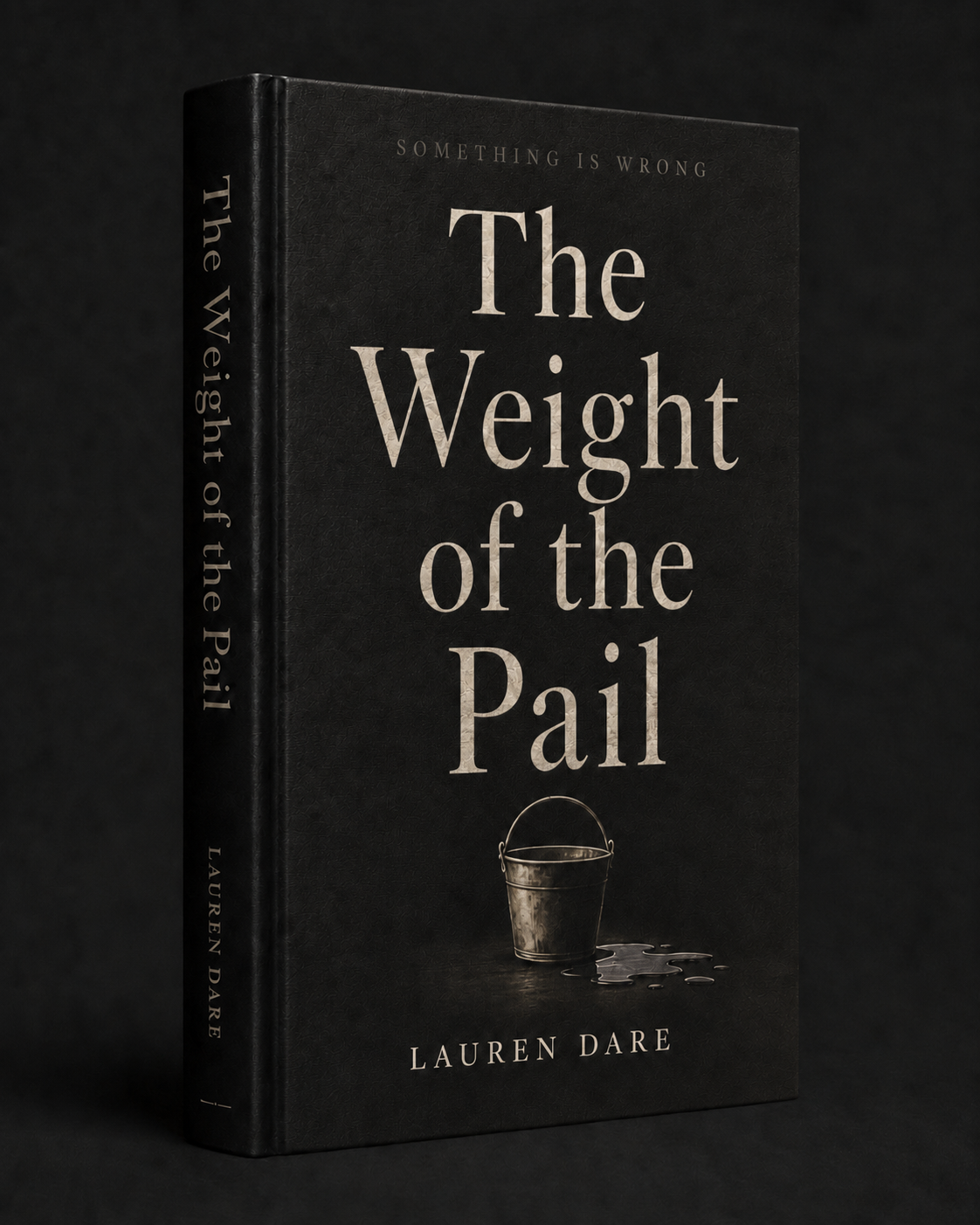
The Weight
of the Pail.
A boy tastes freedom riding a bike without training wheels on Saturday. By Monday, he has learned something more important: how to put the feeling away.
They arrive at school. His mother watches him from her rearview mirror as he struggles with his oversized bag. His piano book, his almost-complete homework, his overdue library book recovered from under the couch, his curated lunchbox designed for long days and his tennis racket all spill out of the top. She is not allowed to help him. The school drop off zone has a strict policy prescribing parents remain in their vehicle. As is usual, his mother reaches for her phone to fill the gap between stopping her wheels and his wobbly decent down from the SUV. Today, her phone is flat.
As he climbs out of the car, careful not to over-balance, he starts off on his walk to his year 1 classroom. She watches him in the side mirror now. She notices his shoulders have changed. His face has closed. She rolls forward.
Unusually, she has a whole fourteen minutes before the next obligation and a dead phone. For the first time in months, she has nothing to look at except the thing she has been not-quite-looking-at since term began. Each piece, examined individually, is defensible. The school is good. The teachers care. The homework is reasonable. It is only when she lets the whole scene slide from the side mirror into her conscious the shape of it becomes visible. Then she blinks and it’s gone.
The Weight of the Pail names what that woman is feeling and why the boy’s Saturday feeling was put away by Monday.
It is not burnout or dissatisfaction and not the backlash of a privileged class against the institutions that made their privilege possible. Something more structural, more ancient and more difficult to see and name. It is difficult because the operating system that produces it also produces the language we use to describe it, the credentials that authorise us to speak and the persistent, sacralised conviction that a life measured is a life well lived.
Drawing on Bergson, Arendt, Baldwin, Weil and two decades of the author’s own reckoning with the architecture she is describing, The Weight of the Pail traces how time was mechanised, labour moralised, school invented and identity made legible to bureaucracies. The architecture is then followed inward into the psyche, where it took up residence as ambition, habit and the quiet hum of productivity that accompanies even the person who thinks she left the system behind. Through moving vignettes, Dare shows how the operating system that governs modern life does not suppress human becoming, it captures it. Becoming is then redirected into performance. The operating system sacralises the performance so completely the foreclosure of possibility is experienced as flourishing. Then, most cruelly, fuses living with proving you are alive until the counterfeit is indistinguishable from the life it replaced.
This is not another critique of late capitalism, nor a manifesto for educational reform nor a parenting manual dressed in philosophy. It is something rarer: a book that sees the architecture clearly from inside the architecture, using the tools the architecture provided and finds in that impossible position not defeat, but the conditions for a different kind of seeing. The argument turns against itself, makes the strongest possible case for everything the system built, literacy, public health, legal equality, the partial democratisation of knowledge. It then shows where that case breaks down, in places the defenders do not expect.
The later chapters move from diagnosis to encounter. A woman in labour whose body refuses the protocol’s grammar. A grandmother whose kitchen holds knowledge no curriculum can certify. A swimmer in the seventh lap who discovers a thought that could not have arrived anywhere else. These are not escapes from the system. They are cracks in it, produced, remarkably, by the system’s own machinery, at the precise point where its performance of becoming gets close enough to the real thing for the distance to become audible.
The Weight of the Pail does not provide a universal prescription. It ends with a five-year-old’s list: drumming, money, opera, motorbikes, green and ham. If you have not read the book, the list is charming. If you have, it is the most radical sentence in it.
noted. you'll hear when it's time.